Last Updated: November 1, 2026
Quick Summary
Political risk is the probability that government decisions, political instability, or regulatory change will damage a project’s value or derail it entirely. Manage it through a three-stage assessment of country, project exposure, and scenarios, then allocate each risk by contract, transfer what you can through insurance or guarantees, and monitor with named owners and escalation triggers.
- Screen the host country first: if the jurisdiction fails, no contractual drafting will fix it.
- The costliest form is often creeping expropriation through tax changes, forced renegotiation, or licence withdrawal.
- The test for mitigation: would it still hold if the signing government lost the next election?
- Allocation is a pricing exercise; a risk allocated but not priced surfaces later, usually during construction.
- A policy that pays after eighteen months does not help a project that runs out of cash in six.
Table of Contents
- Why Political Risk Decides Whether Infrastructure Projects Get Built
- Political Risk Assessment for Infrastructure Projects: A Stage-by-Stage Workflow
- The Main Sources of Political and Regulatory Risk
- Political Risk Mitigation Strategies That Survive Changing Administrations
- Political Risk Allocation in PPP Projects: Who Carries What
- Political Risk Insurance for Infrastructure Projects and Other Transfer Options
- Risk Ownership, Monitoring, and Escalation Across the Project Lifecycle
- Structuring Your Next Project to Survive a Change of Government
- Frequently Asked Questions
Why Political Risk Decides Whether Infrastructure Projects Get Built
Political risk is the probability that government decisions, political instability, or regulatory change will damage a project’s value or derail it entirely. For a practical guide on attracting private capital to public projects, see our dedicated resource.
A project with modest returns and a stable contractual framework will usually attract financing before a high-return project where expropriation, contract enforcement failures, or a change of administration can reset the terms.
Political Risk Assessment for Infrastructure Projects: A Stage-by-Stage Workflow
Most risk assessments fail because they are done once, at financial close, and never revisited. A working assessment runs in three stages, each feeding the next.
Stage 1: Screening the Host Country and Political Climate
Start with the host country, not the project. Screen for institutional stability, contract enforcement record, and the political climate around the next election cycle, using governance indicators, sovereign credit signals, and the treatment of prior foreign investments.
The output is a go/no-go view on the jurisdiction. If the host country fails here, no amount of contractual drafting will fix it.
Stage 2: Mapping Project Exposure and Contractual Framework
Next, map where this specific project is exposed. A toll road, a power plant, and a hospital PPP carry different political risk profiles even in the same country.
Then audit the contractual framework: who grants the concession, what change-in-law protection exists, how disputes are resolved, and whether the governing law and arbitration seat sit outside the host country.
Stage 3: Scenario Planning and Early-Warning Indicators
Build scenarios around plausible political change: a new administration, a budget crisis, a regulatory reversal. For each, model the effect on project exposure and the investment decision it would trigger.
| Stage | Core Question | Output | Owner |
|---|---|---|---|
| 1. Country screen | Can this jurisdiction be financed? | Go/no-go view | Risk and advisory lead |
| 2. Exposure mapping | Where is this project vulnerable? | Risk register and contract audit | Project sponsor and counsel |
| 3. Scenario planning | What would trigger a loss? | Scenarios with warning indicators | Risk committee |
The Main Sources of Political and Regulatory Risk
- Expropriation and nationalisation. Direct seizure is rare; creeping expropriation through tax changes, forced renegotiation, or licence withdrawal is more common.
- Policy and regulatory change. Tariff resets, subsidy removal, or new environmental conditions can alter project economics after close.
- Contract enforcement. Weak courts and slow arbitration turn a contractual right into a theoretical one.
Watch out: the most expensive version of this risk is not a dramatic seizure. It is a slow series of regulatory decisions that erode returns until the sponsor walks away.
Political Risk Mitigation Strategies That Survive Changing Administrations
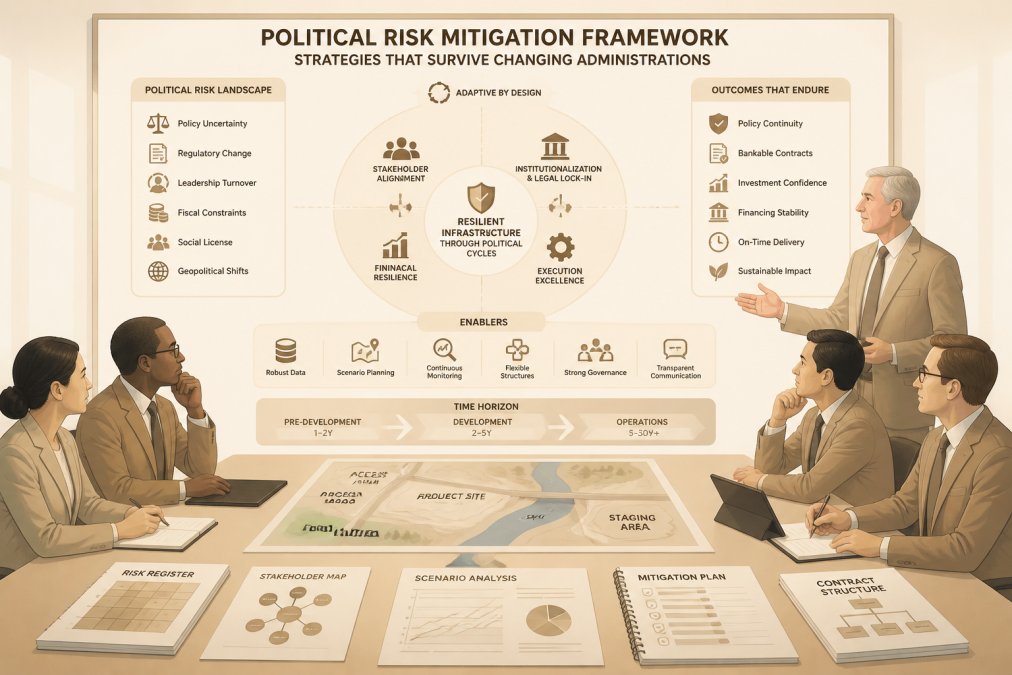
The test for any mitigation strategy is simple: would it still hold if the government that signed it lost the next election? If not, it is not mitigation.
Government Relationships and Stakeholder Engagement
Government relationships are a risk instrument, not a courtesy. A sponsor who only knows the minister who signed the deal has no relationship at all. Build contact across the ministry of finance, the implementing agency, and the credible opposition.
Stakeholder engagement should also reach institutions that outlast administrations: central banks, regulators, and the multilateral lenders whose capital is at stake.
Community, Social Licence, and Distributional Risks
Social licence is the informal acceptance a project needs from surrounding communities, political risk in its most local form. Distributional disputes over land, resettlement, jobs, or tariffs can stop a project faster than any ministry decision.
Fund community engagement properly, document commitments, and treat them as contractual obligations rather than public relations.
Political Risk Allocation in PPP Projects: Who Carries What
Political risk allocation in PPP projects assigns each political and regulatory risk to the party best able to manage it, and prices that assignment into the contract.
The standard allocation matrix, and where it breaks down
The public sector carries risks only it can control, change of law, expropriation, permitting; the private party carries construction, operating, and demand risk where it has real influence. Risks neither party controls, such as war or civil disturbance, are usually shared or transferred to insurers.
In practice, the matrix breaks down at three points:
- Change-in-law risk. The public sector usually accepts it, but the definition matters: discriminatory changes only, or all changes? Project-specific or economy-wide? A narrow definition shifts real cost back to the private party.
- Demand risk. Toll roads and availability-based PPPs allocate demand risk very differently. Where demand risk sits with the private party, political events that suppress traffic, a fuel subsidy removal, a protest movement, a new competing road, can look like commercial risk even when the cause is political.
- Permitting and land risk. The public sector usually carries this, but delay in delivering land or permits is a common cause of cost overrun. The allocation is only meaningful if the contract attaches a consequence, time relief, cost relief, or both, to the delay.
How allocation is priced into the bid
Allocation is a pricing exercise, not a legal drafting one. Each risk the private party carries is priced into its bid through the equity return, the debt margin, or a cost contingency. A risk allocated but not priced will be discovered later, usually during construction.
Compare two bids for the same project: a bidder reading the change-in-law clause as covering all changes will price a larger contingency than one reading it as covering only discriminatory changes. The difference shows up in the tariff or availability payment, which is why procurement documents and draft contracts must be read together, and why bid clarification is a risk-allocation negotiation in disguise.
When reviewing a PPP contract, ask three questions for every risk row: who bears it, what triggers the consequence, and how is the consequence measured? A risk allocated to the public sector with no defined consequence is, in practice, allocated to the private party.
Connecting allocation to the financial model and procurement
Political risk allocation should be visible in the financial model, not just in the contract. Three linkages matter:
- Cash-flow timing. A change-in-law clause providing relief after a defined period still leaves the project funding the gap meanwhile. The model should show the liquidity needed to bridge that period, and the financing should include a facility sized for it.
- Discount rate and cost of capital. Lenders and equity providers price political risk into their required return. Weak allocation means a higher discount rate, which shows up as a higher tariff or a lower bid. Allocation decisions and financing costs are the same conversation.
- Procurement evaluation. If bids are evaluated only on price, bidders who price political risk conservatively lose to those who price it aggressively. Criteria that test the robustness of risk assumptions, or require a risk allocation schedule in the bid, produce more realistic bids and fewer post-award disputes.
The exit question
Allocation also has to survive exit. If an investor sells its stake, does the political risk allocation transfer with the shares, or does the new investor inherit a different position? Concession agreements and financing documents often restrict transfers, and allocation can change on a change of control. Sponsors planning an exit should confirm at financial close that the allocation they negotiated is the one a buyer will inherit.
Political Risk Insurance for Infrastructure Projects and Other Transfer Options
Political risk insurance (PRI) for infrastructure projects compensates the insured investor for losses from defined political events (Political Risk Insurance | World Bank Group Guarantees).
What PRI typically covers, and what it does not
Most political risk policies are built from a small set of coverage lines. The exact wording varies by insurer and by whether the policy is placed with a multilateral, an export credit agency, or a private market underwriter, but the common lines are:
- Expropriation and nationalisation, including creeping expropriation where a series of government measures has an effect equivalent to seizure. This line is most often disputed, because the policy usually requires a defined period of deprivation before a claim can be made.
- Political violence, covering war, civil disturbance, terrorism, and sabotage that damage assets or interrupt operations.
- Currency inconvertibility and transfer restriction, covering the inability to convert local currency or transfer it out of the host country (Currency Inconvertibility and Transfer Restriction Product | World Bank Group Guarantees).
What PRI does not do is equally important. It does not cover commercial risk, such as demand shortfall or counterparty insolvency unrelated to political events. It rarely covers pre-investment sunk costs unless specifically endorsed. It usually excludes losses caused by the insured’s own breach or provoked conduct. And it does not remove the need to pursue the host government first; most policies require the insured to exhaust contractual and arbitral remedies before a claim is payable.
A common and expensive mistake is assuming a policy covers “creeping expropriation” simply because the phrase appears in the schedule. The trigger is usually a defined period of deprivation, often measured in months, and a defined standard of deprivation. If the project’s cash flow is eroded by a series of regulatory decisions that never quite cross that threshold, the policy may not respond. Read the trigger, not the heading.
The mechanics that decide whether cover is useful
Four policy mechanics matter more than the headline coverage list:
- Trigger and waiting period. How long must the deprivation or non-payment last before a claim can be made? A long waiting period can exhaust a sponsor’s liquidity before any recovery arrives.
- Valuation basis. Is the loss measured by book value, investment amount, or discounted cash flow? The difference can be substantial, and lenders and sponsors often want different bases.
- Insured party and loss payee. Lenders usually require to be named as loss payee or to have the policy assigned to them, so a claim payment flows to debt providers first. Negotiate this at placement, not after.
- Recoveries and subrogation. If the insurer pays and then recovers from the host government, how is the recovery shared? This affects the sponsor’s incentive to keep pursuing the government.
Other transfer and mitigation options
PRI is one instrument in a wider set. Each has limits, and the right mix depends on the risk register rather than on a generic checklist.
- Guarantees from multilateral institutions and export credit agencies. These wrap sovereign obligations and can improve tenor and pricing, but take time to arrange and usually require the sovereign to accept the underlying obligation. They are strongest where the sovereign is the payer or guarantor.
- Syndication and co-investment. Spreading the investment across lenders, funds, and development finance institutions reduces any single party’s exposure and can bring in institutions with political leverage. The trade-off is slower execution and more complex governance.
- Offshore revenue structures. Holding cash flows in an offshore account or through an offshore special purpose vehicle protects against transfer restriction and gives lenders a cleaner security package. It does not protect against expropriation of the local asset.
The test for any transfer option is not whether it exists, but whether it responds to the specific event in the risk register, within a timeframe the project can survive, at a valuation the lenders accept. A policy that pays after eighteen months does not help a project that runs out of cash in six.
Risk Ownership, Monitoring, and Escalation Across the Project Lifecycle
Political risk changes continuously, so ownership must be named and monitoring scheduled.
Escalation needs a defined path: the project risk lead reports to the sponsor, the sponsor to the investment committee or board, with pre-agreed triggers for each level.
Monitoring is a governance function, not a reporting one. The question is not whether the risk has changed, but who is now authorised to act on it.
Structuring Your Next Project to Survive a Change of Government
The most bankable projects are designed for the administration after the one that approves them: contractual protection that outlasts the signatory, a diversified capital base, and a political and community constituency with a stake in delivery.
Before the next project reaches the board, run one test: assume the government changes the year after financial close. For guidance on making projects bankable in emerging markets, see Structuring Bankable Projects in Emerging Markets.
Frequently Asked Questions
What is political risk in infrastructure development?
Political risk is the chance that government decisions, political change, or power struggles damage a project’s value. In infrastructure it shows up as expropriation, nationalization, contract enforcement failures, policy change, regulatory decisions, and delays caused by conflicting priorities across public-sector institutions. Because infrastructure assets are fixed, long-lived, and often tied to a host country government, project exposure is concentrated. Investors price that exposure into the cost of capital, so managing political risk directly affects whether a project reaches financial close.
How can political risk be assessed before an infrastructure project begins?
Run a stage-by-stage political risk assessment for infrastructure projects. Screen the host country’s institutional stability, governance record, and political climate first. Then map project exposure: which contracts, permits, and revenue streams depend on government decisions. Build scenarios for political change and define early-warning indicators such as shifts in cabinet composition or budget priorities. The output should be a written assessment that feeds directly into the investment decision and the contractual framework, not a standalone report.
How do political risk insurance and guarantees support infrastructure projects?
Political risk insurance for infrastructure projects transfers specific perils, typically expropriation, political violence, and breach of contract, to an insurer or guarantor. That transfer can raise investment probability because lenders see a defined recovery path. Insurance is not a substitute for mitigation: it covers defined events, not slow regulatory erosion or weak government commitment. Use it alongside a contractual framework and stakeholder engagement plan, and check what each policy actually excludes before you rely on it in the financial model.
How should political risk be allocated in a PPP?
Political risk allocation in PPP projects should assign each risk to the party best able to manage it. The public sector usually retains political and regulatory decisions, policy change, and expropriation. The private party carries construction, operating, and demand risk where it has control. Government commitment is strongest when the allocation is explicit in the project contracts, with clear change-in-law clauses, termination payments, and dispute resolution. Ambiguity here is what turns a political event into a project delay or a default.
The challenge is rarely a shortage of capital. It is proving to lenders and investors that a project can survive the political cycle it will live through. Russell Duke advises governments, sponsors, and EPC firms on structuring infrastructure programmes that hold up across administrations, from risk assessment and PPP allocation through to monitoring and escalation. If you are preparing a project for financing, get in touch to discuss how we would structure it.
